


FOIA for Immigration Cases: What Government Records Can Reveal Before You Make Your Next Move

Updated: 3 days ago
Introduction: Why FOIA for Immigration Cases Can Be a Strategic First Step
When preparing an immigration application, responding to removal proceedings, or considering a new legal strategy, one important question is often overlooked: What information does the U.S. government already have about your immigration history?
Many immigrants rely on documents they have kept over the years, personal recollections, or information provided during previous immigration proceedings. However, government records may contain additional details that are essential to understanding a case.
The Freedom of Information Act (FOIA) allows individuals to request access to certain records maintained by federal agencies, subject to applicable legal exemptions and privacy protections.
In immigration matters, FOIA can be much more than a way to obtain missing documents. It can serve as a strategic tool for identifying inconsistencies, reviewing previous immigration encounters, and helping attorneys evaluate potential legal options.
Understanding your immigration history before making important legal decisions can help you avoid preventable complications.
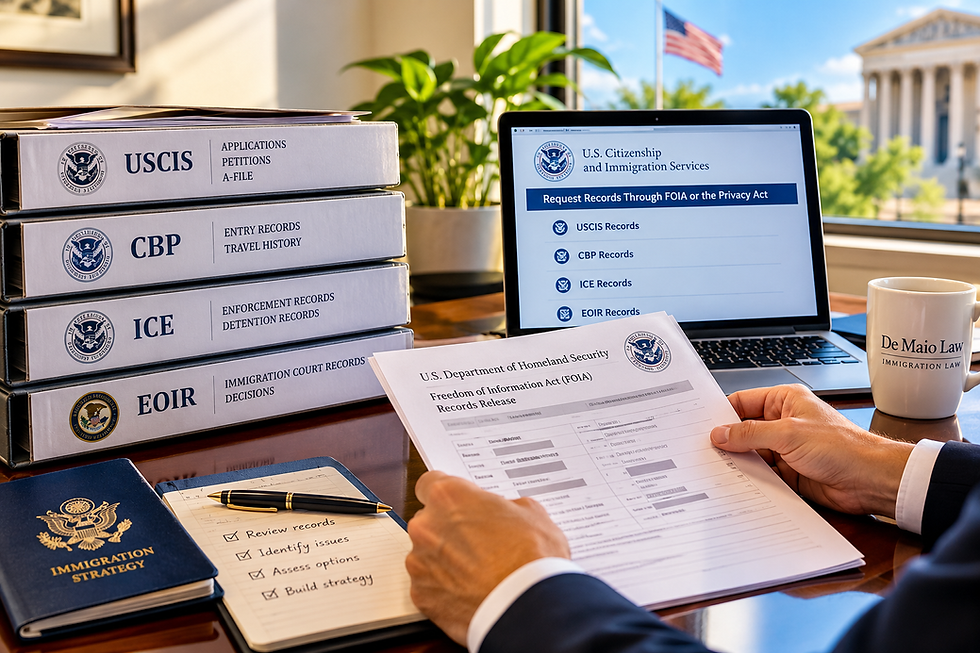
What Is FOIA and Why Does It Matter in Immigration Cases?
The Freedom of Information Act is a federal law that gives individuals the right to request access to records maintained by federal government agencies.
In immigration matters, FOIA requests may help individuals obtain records involving applications, petitions, border encounters, immigration enforcement actions, and certain court proceedings.
The information available depends on which agency maintains the records, the nature of the request, and any applicable restrictions on disclosure.
For example, someone preparing an adjustment of status application may want to review previous immigration filings. Another individual facing removal proceedings may need information about an earlier border encounter or immigration enforcement action.
Rather than relying exclusively on memory or incomplete paperwork, an attorney can review available government records to better understand the client's immigration history.
How FOIA for Immigration Cases Supports Better Legal Preparation
FOIA records may help an immigration attorney:
Verify information previously submitted to immigration authorities.
Identify inconsistencies between past and current applications.
Review records of previous immigration encounters.
Examine certain prior immigration decisions.
Locate documents that a client no longer possesses.
Evaluate whether additional evidence or clarification may be necessary.
Assess potential legal issues before recommending a course of action.
A FOIA response does not automatically establish eligibility for an immigration benefit or guarantee a favorable outcome. Its value lies in the information it may provide for a careful legal assessment.
What Government Records Can FOIA Reveal?
Different federal agencies maintain different categories of immigration records. Understanding which agency holds the relevant information is essential when preparing a request.
1. USCIS: Immigration Applications, Petitions, and A-Files
U.S. Citizenship and Immigration Services (USCIS) maintains immigration records that may include:
Previous immigration applications and petitions.
Supporting documentation submitted with certain filings.
Records of immigration benefits requested or granted.
Certain agency notices and decisions.
Information contained in an individual's Alien File (A-File).
An A-File is an official immigration record that may contain documents collected throughout a person's immigration history.
Reviewing these records may help identify information that could affect future applications or legal strategies.
Official resource: USCIS – Request Records Through FOIA or the Privacy Act
2. CBP: Border Encounters and Travel History
U.S. Customs and Border Protection (CBP) maintains certain records involving entry into the United States and encounters with border authorities.
Depending on the circumstances, available records may include:
Entry and departure information.
Border apprehension records.
Certain inspection records at ports of entry.
Records associated with secondary inspections.
Documentation involving certain border enforcement actions.
These records may be particularly relevant when an individual's manner of entry, travel history, or prior interaction with immigration authorities is important to the case.
Official resource: CBP – How to Submit a FOIA Request
3. ICE: Detention and Immigration Enforcement Records
U.S. Immigration and Customs Enforcement (ICE) maintains records related to certain immigration enforcement activities.
Depending on the case, these records may help clarify:
Previous immigration detention.
Certain enforcement actions.
Detention-related documentation.
Records associated with removal operations.
For individuals who have previously been detained or encountered immigration enforcement authorities, obtaining relevant records may help an attorney reconstruct important events.
Official resource: ICE – Freedom of Information Act
4. EOIR: Immigration Court Records and Previous Proceedings
The Executive Office for Immigration Review (EOIR), part of the U.S. Department of Justice, maintains records relating to immigration court proceedings and appeals before the Board of Immigration Appeals.
These records may include:
Documents filed in immigration court.
Certain motions and supporting materials.
Immigration judge decisions.
Records relating to previous proceedings.
Certain appeal-related documents.
Individuals involved in active proceedings, and their authorized representatives, may also request access to the official Record of Proceeding (ROP) directly through the immigration court or Board of Immigration Appeals without necessarily filing a FOIA request.
Official resource: DOJ – EOIR Freedom of Information Act
When Should You Consider FOIA for Immigration Cases?
Although every immigration situation is different, reviewing government records may be particularly useful at several stages of a case.
Before Filing an Immigration Application
An individual preparing an adjustment of status application, naturalization application, or other immigration benefit request may have a complicated history involving previous filings, entries, or immigration decisions.
Obtaining available records before filing may help identify information that should be reviewed or explained.
For example, discrepancies between a previous application and a new filing may raise questions that an attorney should address before submission.
Before an Immigration Court Hearing
When someone is facing removal proceedings, reviewing available government records may help an attorney understand the procedural history of the case.
This may include evaluating previous immigration encounters, prior applications, or documents that could be relevant to the government's allegations.
However, requesting records does not automatically postpone a hearing or suspend court deadlines. Individuals must continue complying with all applicable immigration court requirements.
Before Changing an Immigration Strategy
An individual may initially pursue one immigration option and later consider a different approach because of changes in personal circumstances or legal eligibility.
Before making that decision, an attorney may need to review previous filings, decisions, or immigration history.
FOIA records can provide information that helps evaluate whether a proposed change presents potential legal concerns.
When Immigration Documents Are Missing
Many immigrants no longer possess copies of documents issued or submitted years earlier.
A FOIA request may help locate certain records, although agencies may not possess every document requested and some information may be withheld.
How FOIA Records Can Reveal Potential Immigration Problems
One of the most important uses of FOIA is identifying information that might otherwise remain unnoticed until an immigration application is reviewed or a legal proceeding advances.
Inconsistencies in Previous Immigration Applications
Government records may reveal differences in dates, addresses, employment history, travel information, or other statements made in earlier applications.
Not every discrepancy indicates wrongdoing. Some may result from mistakes, incomplete information, or misunderstandings.
Nevertheless, identifying inconsistencies before filing a new application allows an attorney to evaluate their significance and determine whether clarification is appropriate.
Previous Immigration Orders or Decisions
Some individuals may be unaware of the full procedural history of an earlier immigration case.
Available records may help determine whether previous decisions, proceedings, or enforcement actions require further legal review.
The consequences of those records depend on the applicable law and the individual's circumstances.
Border Entry and Inspection Information
How a person entered the United States may be relevant to certain immigration benefits.
Government records may provide information about inspections, apprehensions, or other encounters with border authorities.
An attorney can assess how those facts relate to the requirements of a particular immigration benefit.
Missing or Incomplete Immigration History
A person's immigration history may involve multiple agencies and events over many years.
FOIA requests can help reconstruct portions of that history, but responses may be incomplete, redacted, or limited to records maintained by the agency receiving the request.
How to Request Immigration Records Through FOIA
The general process involves identifying the records needed, determining which agency maintains them, preparing the request, and reviewing the agency's response.
Step 1: Identify the purpose of the request.
Determine what information is needed and why it may be relevant to the immigration case.
Step 2: Identify the appropriate government agency.
USCIS, CBP, ICE, and EOIR maintain different categories of records. More than one request may be necessary.
Step 3: Prepare the required identifying information.
Depending on the agency and request, this may include the individual's full name, date of birth, A-Number, and appropriate identity verification or authorization.
Step 4: Submit the request through the authorized channel.
Each agency has its own procedures for receiving and processing records requests.
Step 5: Review the response carefully.
Once records are released, an attorney can evaluate the information, identify potential concerns, and determine whether additional documentation or legal analysis is necessary.
Processing times vary. A FOIA request should not be treated as a substitute for complying with immigration filing deadlines or court obligations.
Can FOIA for Immigration Cases Help Prevent Costly Mistakes?
FOIA cannot eliminate every risk associated with an immigration application or proceeding. However, access to relevant records may help reduce uncertainty.
For example, reviewing previous applications may reveal information that requires clarification before submitting a new filing.
Similarly, records involving earlier immigration proceedings may help an attorney identify procedural issues that should be evaluated before developing a defense strategy.
The objective is not simply to collect documents. It is to understand what those documents mean within the context of the individual's immigration history.
A well-informed immigration strategy begins with an accurate understanding of the facts.
Conclusion: Knowledge Is an Important Part of Immigration Preparation
Immigration decisions can have significant consequences for individuals and their families.
Whether someone is preparing an immigration application, responding to removal proceedings, or considering a different legal strategy, understanding the information already maintained by government agencies can be an important part of preparation.
FOIA provides a mechanism for requesting certain government records that may help clarify immigration history, identify potential concerns, and support informed legal decisions.
At De Maio Law, we recognize the importance of reviewing each client's circumstances carefully and evaluating available information before recommending a legal approach.
The right immigration strategy begins with understanding your case—not making assumptions about it.
Frequently Asked Questions About FOIA for Immigration Cases
❓ 1. What is FOIA in immigration law?
FOIA stands for the Freedom of Information Act. It is a federal law that allows individuals to request access to certain records maintained by government agencies, subject to legal exemptions and privacy protections.
❓ 2. Can I request my entire immigration file through FOIA?
You may request your Alien File (A-File) from USCIS. However, the response may not contain every document related to your immigration history, particularly records maintained separately by other agencies.
❓ 3. Can FOIA reveal previous immigration violations or removal orders?
Depending on the available records, a FOIA response may contain information relating to previous immigration proceedings, enforcement actions, or decisions. An attorney should evaluate the legal significance of any findings.
❓ 4. Should I request FOIA before applying for a green card?
A FOIA request may be useful when there are questions about previous immigration filings, entries, or decisions. Whether it is necessary depends on the individual's circumstances and the information already available.
❓ 5. How long does an immigration FOIA request take?
Processing times vary by agency, request complexity, workload, and the types of records requested. Some requests may take considerably longer than others.
❓ 6. Can my immigration attorney request FOIA records for me?
Yes. An attorney may request records on a client's behalf when the applicable agency's authorization and representation requirements are satisfied.
❓ 7. Does filing a FOIA request stop deportation proceedings?
No. Filing a FOIA request does not automatically stop removal proceedings, postpone immigration court hearings, or extend legal deadlines.
❓ 8. What happens if my FOIA records contain incorrect information?
An attorney can evaluate the discrepancy and determine whether a correction request, additional evidence, or another appropriate legal action may be available. FOIA itself does not guarantee that a record will be corrected.
❓ 9. Can I request records from more than one immigration agency?
Yes. Different agencies maintain different records, so separate requests may be appropriate when the information needed is held by multiple agencies.
❓ 10. Can FOIA guarantee a successful immigration case?
No. FOIA provides access to certain records, not immigration benefits or guaranteed legal outcomes. The information obtained may help an attorney evaluate the case and prepare an informed legal strategy.
Are You Making Immigration Decisions Without Knowing What the Government Has on File About You?
Your immigration history may contain information that could influence your next application, court proceeding, or legal strategy.
Why move forward with unanswered questions when reviewing your government records could help you make a more informed decision?
Contact De Maio Law to discuss your immigration situation and whether a FOIA records review may be appropriate.
De Maio Law, PLLC
📍 301 Almeria Ave, Suite 330, Coral Gables, FL 33134
📞 Phone: 786-232-9120
💬 WhatsApp: 786-440-1672
✉️ Email: info@demaio-law.com
🌐 Website: demaio-law.com
About the Author

Viktor A. De Maio | Immigration Attorney | De Maio Law, PLLC
Viktor A. De Maio is a Florida-licensed attorney with De Maio Law, PLLC, based in Coral Gables, Florida. His practice addresses U.S. immigration legal matters, providing guidance to individuals seeking to understand their immigration options and navigate complex legal procedures.
Have questions about your case?
Talk to an immigration attorney at De Maio Law. Request a case evaluation or message us on WhatsApp at (786) 440-1672. We serve clients in English, Spanish, Italian and Hungarian.
⚠️Disclaimer
This article is for general informational purposes only and does not constitute legal advice or establish an attorney-client relationship. Immigration laws and procedures may change; consult a qualified attorney about your specific circumstances.


Comments