


🧭 I-220A Explained: Latest Immigration Court Trends & Legal Impact in 2026

Updated: 3 days ago
INTRODUCTION
The I-220A (Order of Release on Recognizance) remains one of the most complex and heavily litigated instruments within the U.S. immigration system in 2026.
Issued by ICE (Immigration and Customs Enforcement), this document allows an individual to be released under supervision while their immigration proceedings continue in immigration court. However, its legal nature has created significant litigation because it:
does not constitute immigration status
is not a formal admission under the INA
is not automatically equivalent to parole
depends heavily on judicial interpretation for adjustment of status purposes
In recent weeks of 2026, the I-220A has returned to the center of legal debate due to new federal court decisions and ongoing litigation regarding its impact on adjustment eligibility under the Cuban Adjustment Act (CAA) and its interpretation under the concept of “inspection and admission.”
At the same time, a recurring professional and academic question has emerged:
What would happen to individuals under I-220A if Cuba were to undergo a democratic transition?
It is essential to clarify from the outset that, as of this analysis, there is no law, USCIS regulation, or binding judicial precedent that connects political changes in Cuba with any modification to the legal treatment of the I-220A. Any discussion in that direction belongs strictly to the realm of doctrinal or hypothetical legal analysis, not current immigration policy.
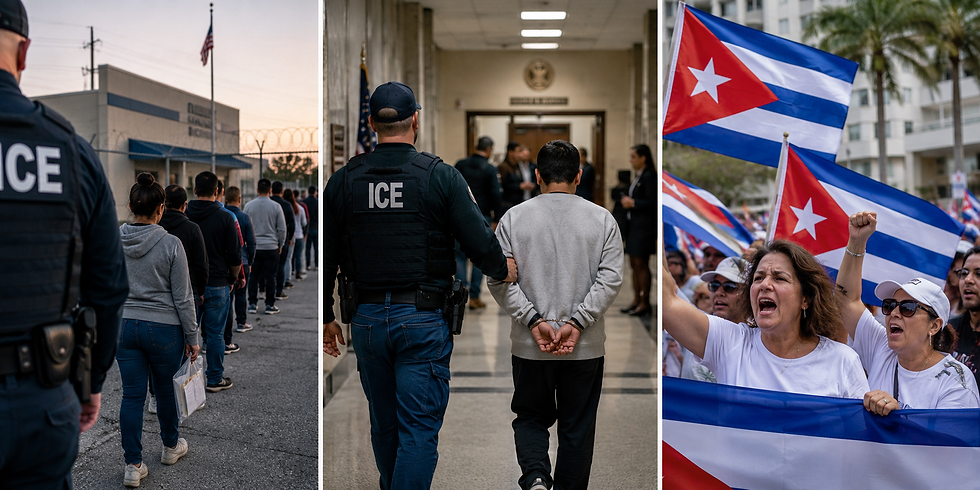
⚖️ LEGAL NATURE OF THE I-220A
The I-220A is an Order of Release on Recognizance issued by ICE to release individuals from detention under specific supervisory conditions.
Key legal characteristics:
❌ Does not confer immigration status
❌ Does not constitute lawful admission under the INA
❌ Is not equivalent to parole under INA §212(d)(5)
✔ Allows physical release under supervision
✔ Imposes mandatory ICE compliance conditions
✔ Can be revoked at agency discretion
📌 From a strict legal perspective, the I-220A places an individual in a state of authorized physical presence without formal immigration admission, which is precisely what creates complexity in adjustment of status litigation.
⚖️ CURRENT LEGAL LANDSCAPE (2026)
In 2026, the legal interpretation of the I-220A remains unsettled nationwide.
The most litigated issues include:
definition of “inspection and admission” under INA §245
whether I-220A can be treated as a functional substitute for parole
eligibility for adjustment of status under the Cuban Adjustment Act
inconsistent interpretations across federal jurisdictions
📌 This has resulted in a fragmented jurisprudential landscape, where case outcomes depend heavily on the federal circuit and the discretionary analysis of immigration judges or USCIS officers.
🌍 LEGAL ANALYSIS: POTENTIAL DEMOCRATIC TRANSITION IN CUBA AND ITS RELATION TO THE I-220A
⚠️ Fundamental clarification (current state of law)
Before any legal analysis, it must be clearly established that:
There is no existing legislation linking I-220A to Cuba’s political system
There is no USCIS guidance addressing such a scenario
There is no binding federal court precedent on this issue
There is no statutory change to the Cuban Adjustment Act
Therefore, any analysis on this topic must be understood as prospective doctrinal interpretation, not current immigration policy or binding law.
⚖️ 1. CUBAN ADJUSTMENT ACT: CURRENT LEGAL FRAMEWORK AND INDEPENDENCE FROM FUTURE POLITICAL CONDITIONS
The Cuban Adjustment Act (CAA) remains a federal statute that allows certain Cuban nationals to adjust status under specific statutory requirements.
In current practice, the legal requirements focus on:
inspection and admission or parole
physical presence in the United States
statutory eligibility under the Act
📌 The key legal point is that the CAA is a fixed statute. Its application depends on its current legal text, not on hypothetical political developments in the country of origin.
Accordingly, any I-220A-based claim today is analyzed under:
INA §245
interpretation of “admission”
existing federal case law
and not on external political projections.
🧠 2. DOCTRINAL ANALYSIS: WOULD A DEMOCRATIC TRANSITION IN CUBA AFFECT THE LEGAL INTERPRETATION OF THE I-220A?
From a purely doctrinal standpoint, some academic discussions have explored whether structural changes in a country of origin could indirectly influence immigration policy interpretation.
However, under U.S. immigration law, a fundamental principle applies:
Immigration statutes are interpreted based on their current statutory language, not on external political conditions of the country of origin, unless Congress explicitly legislates otherwise.
This means:
The legal nature of the I-220A does not change
The definition of “admission” is not redefined by external geopolitical factors
USCIS cannot modify statutory interpretation based on hypothetical scenarios
Only Congress can amend the INA or the Cuban Adjustment Act
📌 Any potential impact would therefore be indirect, legislative, and future-oriented—not automatic or interpretive.
⚖️ 3. CURRENT POSITION OF COURTS AND USCIS (2026)
In current practice:
USCIS adjudicates I-220A cases strictly under INA §245
Federal courts evaluate factual circumstances of entry and custody
There is no binding precedent linking Cuba’s political status to admissibility analysis
📌 This is critical: adjudication is fact-based, individualized, and grounded in immigration entry and custody records, not geopolitical forecasting.
🚨 CURRENT IMMIGRATION RISKS ASSOCIATED WITH THE I-220A
In 2026, documented risks include:
inconsistent interpretation across federal jurisdictions
denials based on lack of “inspection and admission”
increased federal litigation activity
ICE detention during scheduled check-ins in certain cases
ongoing uncertainty regarding adjustment eligibility
❓ FREQUENTLY ASKED QUESTIONS (FAQS)
1️⃣ 🧭 Is the I-220A a legal immigration status?
No. The I-220A is not a recognized immigration status under the INA. Legally, it is a discretionary release mechanism issued by ICE.
This distinction is critical because it means the individual:
has not been formally admitted into the United States
does not hold lawful immigration status
remains in active immigration or removal proceedings
📌 Legally, the I-220A does not create immigration rights; it only allows temporary physical release under supervision while proceedings continue.
2️⃣ ⚖️ Can the I-220A be considered equivalent to parole?
There is no automatic equivalency or uniform recognition.
Some litigation arguments attempt to treat the I-220A as functionally similar to parole; however:
parole is statutorily defined under INA §212(d)(5)
the I-220A is an administrative release mechanism
federal courts and USCIS do not apply a uniform classification
📌 As a result, its treatment depends on jurisdiction-specific legal interpretation rather than a nationwide rule.
3️⃣ 🌍 Would a democratic transition in Cuba automatically change I-220A cases?
No. Under U.S. immigration law, changes in foreign political conditions do not automatically alter the legal interpretation of immigration documents such as the I-220A.
Even in hypothetical scenarios involving political transformation in Cuba:
the I-220A would continue to be analyzed under existing INA provisions
pending cases would be decided based on current statutory law
any structural change would require Congressional action
📌 U.S. immigration law does not operate on geopolitical speculation; it requires explicit statutory authority.
4️⃣ 🧠 Why is the I-220A so controversial in 2026?
Because it sits at the intersection of three unresolved legal tensions:
lack of statutory definition for the I-220A
inconsistent interpretation of “admission” under the INA
non-uniform application of the Cuban Adjustment Act
This has resulted in:
contradictory federal court outcomes
divergent litigation strategies
high volume of individualized legal challenges
📌 Technically, the I-220A remains in a legal “gray zone” within modern immigration law.
5️⃣ ⚖️ Is legal analysis necessary before filing an I-220A-related case?
Yes—critically.
I-220A cases require:
detailed entry and custody analysis
INA §245 eligibility review
jurisdiction-specific case law evaluation
strategic legal framing based on recent precedent
📌 A misinterpretation at the filing stage can significantly affect both current outcomes and future immigration credibility assessments.
🧭 CONCLUSION
The I-220A in 2026 remains one of the most complex and litigated areas in U.S. immigration law.
Its legal interpretation depends exclusively on current statutory frameworks, federal jurisprudence, and individualized factual analysis.
There is no active legal connection between political changes in Cuba and the treatment of the I-220A under USCIS or immigration courts.
📞 LEGAL CONTACT INFORMATION
🏢 301 Almeria Ave, Suite 330Coral Gables, FL 33134
📱 Phone: (786) 440-1672
📞 Office: (786) 232-9120
💬 WhatsApp: (786) 440-1672
📧 Email: info@demaio-law.com
👨⚖️ AUTHOR OF THE BLOG

Viktor A. De Maio, Esq.
Immigration Attorney | Federal Litigation | Immigration Court Defense
Immigration attorney and founder of De Maio Law, focusing on complex immigration litigation, removal defense, asylum, citizenship, and federal immigration matters.
He is admitted to practice in Florida, federal courts, and all U.S. immigration courts. He represents clients in proceedings before USCIS, ICE, and federal courts, with a focus on advanced legal strategy, jurisprudential analysis, and complex immigration defense.


Comments